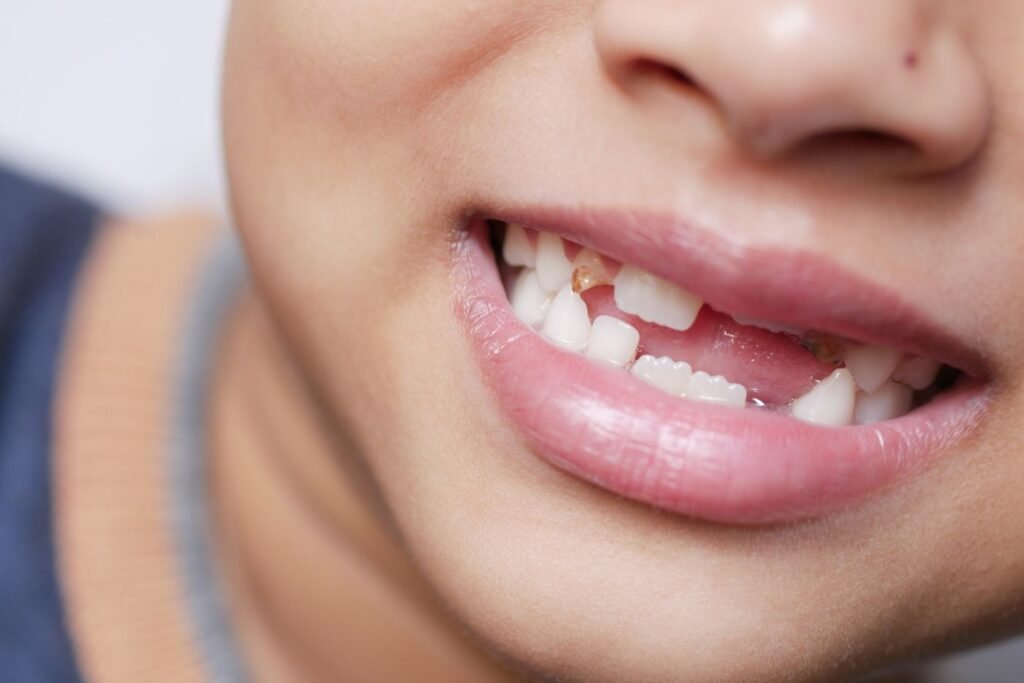
Most children lose their first baby tooth between ages 5 and 7, usually a lower front tooth, and finish losing all 20 by about age 12 or 13. Losing teeth a year earlier or later than friends is common and usually normal. Losing a tooth before age 4, or having no loose teeth by age 8, is less common and worth checking at a pediatric dentistry visit, along with any tooth knocked out early by injury.
The first wobbly tooth is a big moment. There’s excitement, a bit of nervousness and, in many homes, a visit from the tooth fairy. Parents also tend to have questions. Is this too early? Why is the adult tooth coming in behind? Should we pull it?
The timing usually follows the order the baby teeth came in. Girls often lose teeth slightly earlier than boys. Regular preventive dentistry visits, with an X-ray when needed, show whether adult teeth are developing on schedule underneath.
This stage is also when crowding often shows up for the first time, because adult teeth are bigger than baby teeth. Early checks help decide if and when orthodontic care like clear aligners might be useful later.
At Dara Dental Clinic, kids’ visits are relaxed and unhurried, which makes this stage easier for everyone. You can learn more about the clinic and how the team works with families.
What’s the usual order of losing baby teeth?
Baby teeth usually fall out in roughly the same order they came in, starting with the lower front teeth around age 6 and ending with the second molars around age 10 to 12.
| Baby tooth | Typical age it falls out | Adult tooth that replaces it |
|---|---|---|
| Lower central incisors | 6 to 7 | Lower central incisors |
| Upper central incisors | 6 to 8 | Upper central incisors |
| Lateral incisors | 7 to 8 | Lateral incisors |
| First molars | 9 to 11 | First premolars |
| Canines | 9 to 12 | Canines |
| Second molars | 10 to 12 | Second premolars |
How do baby teeth fall out?
As an adult tooth develops underneath, it slowly dissolves the root of the baby tooth above it (a process called resorption). With less root holding it, the baby tooth gets wobbly and eventually falls out, usually with very little bleeding.
Once a tooth is loose, it can take anywhere from a few days to a couple of months to come out.
Is it normal to lose teeth early or late?
Early loss can sometimes be linked to decay, injury or, rarely, a medical condition. Late loss can mean an adult tooth is missing, blocked or developing slowly. An X-ray usually explains it quickly.
What are “shark teeth”?
Sometimes an adult tooth comes in behind a baby tooth that hasn’t fallen out yet, creating a double row. It’s most common with the lower front teeth and often looks alarming to parents.
In many cases, the baby tooth loosens and falls out within a few weeks, and the tongue gradually pushes the adult tooth forward into place. If the baby tooth is still firm after 2 to 3 months, or the adult tooth is well behind, a simple extraction of the baby tooth may be recommended.
Should you pull a loose baby tooth?
Usually, let it come out naturally. Encourage your child to wiggle it gently with a clean finger or their tongue. Most teeth fall out on their own while eating or brushing.
- Okay to help: if the tooth is hanging by a thread and bothering your child, a quick, gentle twist with a clean tissue is fine.
- Don’t force it: pulling a tooth that’s still firmly attached hurts, can bleed more and may break the root.
- Skip the string-and-door tricks. They’re more likely to cause pain and fear than help.
What should you do after a baby tooth falls out?
- Have your child rinse with water.
- Press a clean piece of gauze or tissue on the spot for a few minutes if it bleeds.
- Offer soft, cool foods for the rest of the day if the gum is tender.
- Keep brushing gently around the area.
- Call the clinic if bleeding continues beyond 15 to 20 minutes of pressure or the gum swells.
What if a baby tooth is knocked out?
Injuries are common at this age. Unlike an adult tooth, a knocked-out baby tooth should not be put back in, because it can damage the adult tooth developing underneath.
- Apply gentle pressure with gauze to stop bleeding
- Use a cold compress for swelling
- Keep the tooth to show the dentist
- Call the clinic the same day so the area and the adult tooth can be checked
How do you care for teeth during the “mixed dentition” years?
Between about 6 and 12, kids have a mix of baby and adult teeth. It’s a high-risk time for cavities, because new adult teeth have immature enamel and gaps make brushing awkward.
- Brush twice a day with a pea-sized amount of fluoride toothpaste.
- Help with brushing until about age 8, then check regularly.
- Floss wherever teeth touch.
- Ask about sealants for the 6-year and 12-year molars.
- Keep sugary snacks to mealtimes.
- Use a mouthguard for sports.
- Keep 6-month checkups to monitor how adult teeth are coming in.
When should a child see an orthodontist or have an orthodontic check?
The Canadian Association of Orthodontists and similar groups suggest a first orthodontic check by about age 7. At that point, a dentist can spot:
- Severe crowding or spacing
- Crossbites or underbites
- Adult teeth that are missing or impacted
- Habits like thumb sucking affecting the bite
Most children won’t need treatment that early. The check simply shows whether to monitor or act.
Myths about losing baby teeth
- “Baby teeth don’t matter, they fall out anyway.” Back baby teeth stay until 10 to 12 and hold space for adult teeth. Decay in them can still cause pain and infection.
- “Losing teeth early means my child is advanced.” Timing has little to do with development in other areas.
- “Crooked adult teeth will always straighten on their own.” Some improve as the jaw grows. Others need help.
- “Adult teeth are yellow because of poor brushing.” New adult teeth naturally look a bit more yellow next to brighter baby teeth.
Real-life examples
Common mistakes
- Pulling teeth before they’re ready
- Assuming yellow-looking adult teeth need whitening (whitening isn’t recommended for young teens)
- Skipping checkups during the “in-between” years
- Letting brushing slide once a child seems independent
- Replanting a knocked-out baby tooth
Does losing teeth hurt?
Usually very little. By the time a baby tooth is ready to fall out, most of its root has dissolved, so there’s not much holding it in. Kids may feel a pinch or a bit of soreness when it finally comes out, and some light bleeding is normal.
The gum where the adult tooth is pushing through can feel tender or itchy for a few days. Cold foods, a cool washcloth to chew on, and age-appropriate pain relief (if your pharmacist says it’s suitable) can help.
If your child has ongoing pain, swelling or a bad taste around a loose tooth, it may be decay or infection rather than normal loosening, and it’s worth a check.
How can you make losing teeth a positive experience?
- Talk about it early. Explain that losing teeth means they’re growing up, and that new teeth are on the way.
- Read a story. Picture books about losing teeth help younger kids feel prepared.
- Keep a tooth chart. Many children love tracking which teeth have come out.
- Celebrate calmly. A small tradition makes it fun without turning it into a big worry.
- Keep dental visits positive. Avoid using the dentist as a threat (“if you don’t brush, the dentist will…”). It builds fear that can last into adulthood.
Where can your family get gentle care in Thornhill?
Choose a practice where the dentists are registered with the Royal College of Dental Surgeons of Ontario (RCDSO), and where kids feel relaxed rather than rushed.
Dara Dental Clinic is a modern family dentist Thornhill parents appreciate for unhurried, warm and refined care, combining craftsmanship with quiet hospitality. As a pediatric dentist Thornhill families can rely on, the team keeps visits calm, explains each step to children and focuses on prevention.
Services also include preventive dentistry (cleanings, exams and fillings), teeth whitening, dental implants, dental veneers and clear aligners, with advanced technology and patient comfort for all ages in Thornhill and nearby communities. Call 647-699-9485, email info@daradentalclinic.ca, or visit Suite 116, 8188 Yonge Street, Vaughan, Ontario L4J 0M2. Booking online at https://daradentalclinic.ca/ is quick.
Frequently asked questions
What age do kids lose their first tooth?
Usually between 5 and 7, most often a lower front tooth. Anywhere from about 4.5 to 7.5 is generally considered normal.
How many baby teeth do children lose?
All 20 baby teeth are replaced by adult teeth, usually by age 12 or 13.
Is it normal for an adult tooth to come in behind a baby tooth?
Yes, it’s common and called “shark teeth.” The baby tooth often falls out within weeks; if not, a dentist may remove it.
Should I worry if my 8-year-old hasn’t lost any teeth?
It’s worth a dental check. An X-ray can confirm whether adult teeth are developing normally or if any are missing.
Do kids need to see a dentist when they lose a tooth?
Not for normal tooth loss. Call if a tooth is lost early from injury or decay, if bleeding won’t stop, or if there’s swelling.
Conclusion
Most kids lose their first baby tooth around age 6 and their last around age 12.
A year early or late is usually normal, while very early loss or no loose teeth by 8 deserves a check.
Regular visits during these years help adult teeth come in healthy and straight.